
The complete guide to driving in Greece for UK travellers
Are you ready to drive in Greece? You’ll need to pack:
- Your UK driving licence, passport, insurance certificate and V5
- Some drivers may also need a UK sticker and an international driving permit
Greece is hard to beat when it comes to road trip destinations. Picture motoring through dramatic mountain terrain or coasting alongside turquoise waters, stopping only for a swim, a fresh seafood lunch or to discover yet another ancient historical attraction.
UK drivers will generally find driving in Greece relatively straightforward. All you’ll need is to pack all the right documents and learn how the rules of the road differ between Greece and the UK. With a bit of preparation, you can enjoy a smooth, dreamy road trip in this stunning part of Europe.
Documents and requirements for driving in Greece
Hitting the road in Greece? Make sure you have these documents in your possession:
- Full and valid UK driving licence
- Passport
- Motor insurance certificate
- V5 registration document
- UK sticker
- International Driving Permit (IDP)
Full, valid UK driving licence
Can I drive in Greece with a UK licence? Absolutely! You’ll need to keep your UK driving licence on you when motoring in Greece. A photocard licence is preferable, as this way you shouldn’t also need an International Driving Permit (IDP), but a paper licence is acceptable alongside an IDP (more on that later).
Passport
You’ll need your passport to enter Greece, but this will also serve as proof of ID. While you’ll already have your driving licence on you, it’s also important to have a second proof of ID when motoring in the Mediterranean country.
Are you planning to rent a car, rather than driving your UK vehicle over to Greece? You’ll most likely be asked to show a second form of ID before being handed the keys.
Motor insurance certificate
All UK vehicle insurance provides at least the minimum third party insurance needed to drive in EU countries. Before setting off, check what level of cover you have for driving in the EU, as you may want to upgrade. Either way, if you’re driving your own car in Greece, keep your motor insurance certificates inside the car.
If you’re renting a car, you’ll simply purchase an insurance policy from the car hire provider.
V5 registration document
Driving your own car? Your V5 (or V5C) vehicle registration document is your vehicle logbook, so make sure this is in your car before setting off.
However, if you’re hiring a car in the UK to take to Greece, you’ll need to get a VE103 from your car rental provider. This legal document proves you have the permission of the vehicle owner (in this case, the hire company), to take the car abroad.

UK sticker
If you’re driving a UK vehicle in Greece, you may need to display a white, oval shaped sticker that reads ‘UK’ on the back of your car. Whether or not you need to affix a UK sticker depends on your number plate. Here’s how it works.
If your number plate features the UK identifier alongside a Union Jack, you do not need to display a UK sticker.
However, you must use a UK sticker if your number plate displays:
- No flag or identifier
- A GB identifier with the union Jack
- An EU flag
- A national flag of England, Scotland or Wales
It’s important to note that you must use a ‘UK’ sticker – not a ‘GB’ sticker. If you have a GB sticker already attached to your car, cover or remove it before driving outside the UK.
When affixing the sticker to the back of your car, avoid putting it on the number plate.
International Driving Permit (IDP)
An International Driving Permit, or IDP, is essentially a translation of your driving licence required for motoring in certain countries.
For the most part, UK drivers do not need an IDP in order to drive around most EU countries. However, there are a number of exceptions.
You’ll may need to get an IDP ahead of your road trip in Greece if:
- You have a paper driving licence, not a photocard one
- Your licence was issued in Gibraltar, Guernsey, Jersey or the Isle of Man
- You’re hiring a car in Greece
There are three different types of IDP available – Greece uses the 1968 version. You can pick one up quickly and easily from shops that have PayPoint ( find your closest one here). You’ll need to take your UK driving licence, a passport-sized photo, your original passport, and the £5.50 application fee. The process should only take a few minutes.
Driving in Greece: rules of the road
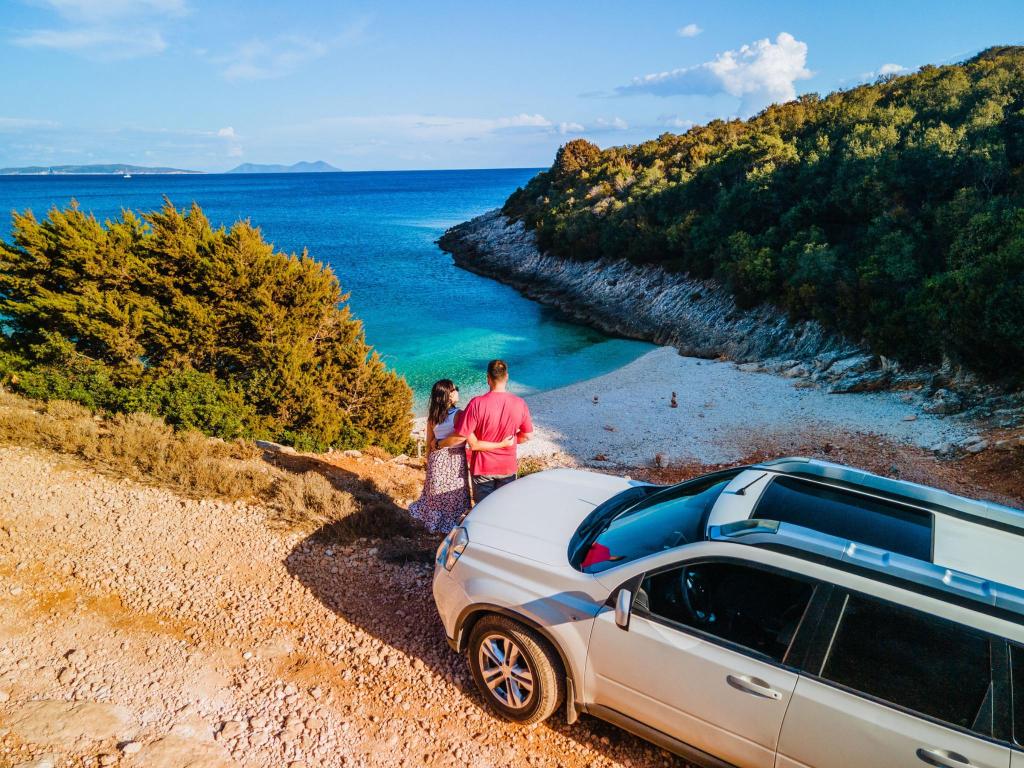
There are a few key differences between driving in Greece and the UK.
Here are the main ones to be aware of:
Drive on the right-hand side of the road
What side of the road does Greece drive on? Greek motorists drive on the right – this is the single biggest difference between motoring in the two countries. This means that overtaking, roundabouts and junctions may feel reversed to UK drivers.
Speed limits
Standard speed limits in Greece are:
- Built-up areas: 50 kph (31 mph)
- Outside built-up areas: 90 kph–110 kph (56 mph–69 mph), depending on roadside signage
- Motorways: 130 kph (81 mph)
However, speed limits can vary, so it’s vital to check local signage. Special speed limits apply to newly-qualified drivers, as well as certain classes of vehicle (for example, mopeds, motorhomes and cars with trailers).
You should also bear in mind that road signs in Greece are displayed in kilometres per hour (kph) rather than miles per hour (mph).
Driving age
The driving age in Greece is 18 – higher than the UK’s 17-year-old limit. While the driving age in Greece for tourists doesn’t differ to the limit for locals, those hoping to rent a car must be aware that car hire providers in Greece typically have stricter limits on who they will loan a vehicle to. Many companies won’t rent a car out to anyone younger than 21, and some will add extra fees for drivers under the age of 25.
Roundabouts
It’s essential to take extra care on roundabouts in Greece because the rules can vary significantly from roundabout to roundabout. Never assume UK rules apply – on some Greek roundabouts, vehicles entering the system have right of way over those already on the roundabout. Signage near the roundabouts should explain how each one works.

Alcohol
While it’s always safest never to drink before getting behind the wheel, it’s worth noting that Greece has stricter rules around this than the UK. Indeed, the European country has a blood alcohol content limit of 0.05% for drivers, compared to the UK’s 0.08%. Furthermore, new drivers (less than two years’ experience) and professional motorists have a stricter limit of 0.02% BAC.
Use of horns
While UK drivers are relatively restrained when it comes to horn usage, in Greece, horns are often used as a warning. In some mountain villages, for example, you may be expected to beep when approaching a blind bend.
Mobile phones
Just like in the UK, using a handheld mobile phone while driving is strictly prohibited, with heavy fines for those who break the rules.
Special considerations for driving in Greece for UK drivers
Now you’ve sorted all your documents and familiarised yourself with Greece’s motoring rules, you’re almost ready to hit the road. Here are a few more vital bits and pieces to sort out first.

Safety equipment
There are a number of items of safety equipment motorists in Greece must carry by law.
Whether you’re renting a car in the UK or Greece, or driving your own motor across, you must ensure you keep the following safety equipment in your car:
- Warning triangle: you’ll use this to alert other road users if you have a breakdown or are involved in an accident.
- Fire extinguisher: you’re required to carry this by law in case of vehicle fires.
- First aid kit: for treating minor injuries at the roadside until more help arrives.
- A high-vis jacket for each occupant of the car: these must be worn when exiting the vehicle in the event of a breakdown or accident.
Headlamp beam deflectors
If you’re driving a car from the UK in Greece, you may need to invest in some headlamp beam deflectors. This is because UK vehicles are designed to drive on the left-hand side of the road, but Greek motorists stick to the right side. When driving a UK car on the right-hand side of the road, the headlights are angled in a way that could dazzle oncoming traffic.
Some cars come with headlight adjusters, which means you can manually change the direction of the beam. If not, you can buy headlamp beam deflectors, which you can simply stick onto your lights to change the beam’s direction and avoid dazzling your fellow drivers.
Driving conditions
It’s worth being aware of the driving conditions in Greece before setting off on your road trip.
First up, many Greek roads are narrow, steep and winding (and often feature blind bends) especially on islands and in rural, mountainous areas. With this in mind, it’s worth bearing in mind it may take you longer to reach your destination than your GPS predicts.
Greek highways are usually in good condition, but bear in mind that smaller local roads are sometimes poorly maintained, with potholes and limited lighting.
Motorway tolls
You’ll find motorway tolls on Greece’s major highways, and on some bridges and in tunnels. Most toll booths accept cash or card, but keeping some Euros (€) handy is a good idea. There’s also the option to get an electronic tag for your car, which gets you through toll booths faster, and – in some cases – can get you a discount. The charge varies depending on vehicle type and distance travelled.
Parking
Planning to park in any of Greece’s cities or popular tourist areas? Bear in mind that cars parked illegally often get clamped or towed here.
Look out for blue lines. These usually indicate a paid parking zone – typically you’ll buy parking vouchers at nearby kiosks. White lines normally indicate free parking, unless nearby signage suggests otherwise. And if you see yellow lines, don’t stop: these are no parking zones.

Low emission zones
Athens and Thessaloniki both operate low emissions zones, but most motorists from the UK are not affected by the rules.
Thessaloniki’s low emissions restrictions apply mainly to heavy diesel vehicles.
Meanwhile, Athens’ central area operates an odd/even number plate scheme, designed to cut congestion in the capital. On weekdays with even calendar days, cars with number plates ending in even numbers can enter the zone and on the odd days, only cars with odd number plates can enter.
However, cars with certain green credentials are permitted to enter every day, including electric and hybrid vehicles. Tourist and foreign-registered vehicles (including UK cars) are generally exempt for up to 40 days. This means that, as long as you’re staying for less than 40 days, you shouldn’t need to worry about being caught by Athens' low emissions zone rules.
Climate
Greece experiences temperature extremes, with highs regularly surpassing 30°C in the summer months, while northern areas and mountains often see snow in winter.
Visiting in summer? Bear in mind that cars can easily overheat, so you should always carry water and never leave children or pets inside. Furthermore, wildfires are common in the hotter months, when it’s essential you avoid driving into fire zones.
In winter you may need to pack snow chains, especially if you plan to motor in mountainous areas.
Emergency numbers
The odds are you’ll enjoy a smooth, enjoyable road trip through Greece. But in the event of an emergency, who should you call?
- EU-wide general emergency number: 112
- Police: 100
- ELPA Roadside assistance (similar to the AA): 10400
- Ambulance: 166
- Fire brigade: 199
- British Embassy (Athens): +30 210 7272 600

- Khách đi một mình
- Du lịch tiết kiệm
- Mẹo đi máy bay
- Du lịch mạo hiểm
- Du lịch phố thị
 Airport hacks: how to make it through without spending moneyngày 28 tháng 11 năm 2025
 Budget flights: cabin bag vs hold bagngày 28 tháng 11 năm 2025
 Can dogs fly on planes to Europe?ngày 28 tháng 11 năm 2025
 Is airport fast track worth it?ngày 28 tháng 11 năm 2025
 Premium airport lounge: pros, cons and what to expectngày 28 tháng 11 năm 2025
 Premium vs budget airlines: what to expect on boardngày 28 tháng 11 năm 2025
 The complete guide to driving in France for UK travellersngày 28 tháng 11 năm 2025
 Where do dogs go on a plane?ngày 28 tháng 11 năm 2025
 17 tips to manage a fear of flyingngày 16 tháng 10 năm 2025
 18 travel tips for first-time flyersngày 16 tháng 10 năm 2025
 20 airport hacks from seasoned travelersngày 16 tháng 10 năm 2025
 What to pack in your carry-on luggage: Everything you needngày 16 tháng 10 năm 2025
 Holiday car hire: the ultimate guide to driving in Europengày 1 tháng 10 năm 2025
 How to get an International Driving Permitngày 1 tháng 10 năm 2025
 The complete guide to driving in Italy for UK travellersngày 1 tháng 10 năm 2025
 The complete guide to driving in Spain for UK travellersngày 1 tháng 10 năm 2025
 The complete guide to London airportsngày 1 tháng 10 năm 2025
 The ultimate Bangkok airport guidengày 1 tháng 10 năm 2025
 Travel to Europe from UK: everything you need to knowngày 1 tháng 10 năm 2025
 What is an automatic car in car rental?ngày 1 tháng 10 năm 2025
 8 tips for using the overhead airplane luggage compartmentngày 5 tháng 8 năm 2025
 Should you rent a manual or automatic car?ngày 4 tháng 8 năm 2025
 Airplane Etiquette: The Biggest Dos and Don'ts When Flyingngày 3 tháng 4 năm 2025
 One-Way vs Round-Trip Flights: What's the Difference?ngày 28 tháng 3 năm 2025
 Domestic vs International Flights: What Are the Differences?ngày 24 tháng 2 năm 2025
 Top Tips for Booking Multi-City Flightsngày 30 tháng 12 năm 2024
 What Happens if You Miss Your Flight?ngày 10 tháng 12 năm 2024
 What Can’t You Take On A Plane?ngày 15 tháng 8 năm 2024
 How To Choose The Best Seats On A Planengày 24 tháng 7 năm 2024
 Expert Tips on the Best Times and Days to Book Flightsngày 24 tháng 7 năm 2024
 How to Find and Book Affordable Flightsngày 24 tháng 7 năm 2024
 How to Navigate an Airport Like a Pro: From Check-in to Arrivalsngày 24 tháng 7 năm 2024
Có thể bạn cũng sẽ thích

Navigate the roads of France with confidence! Our guide for UK travellers driving in France covers everything you need to know for a hassle-free trip.
Planning on driving in Greece? Our guide for UK travellers covers everything from driving laws to essential tips for a hassle-free trip.

Planning to pick up a rental car? Follow these car rental tips to know exactly what to bring with you for a seamless start to your journey.

Involved in a rental car accident? Discover essential steps to take rental car after accident steps to take after an accident in a rental car.

Learn 8 practical car rental tips to save on your next car rental, from booking strategies to avoiding hidden fees.

Returning your rental car doesn't have to be stressful. Follow our 8 easy steps for a hassle-free experience and save time and effort.